

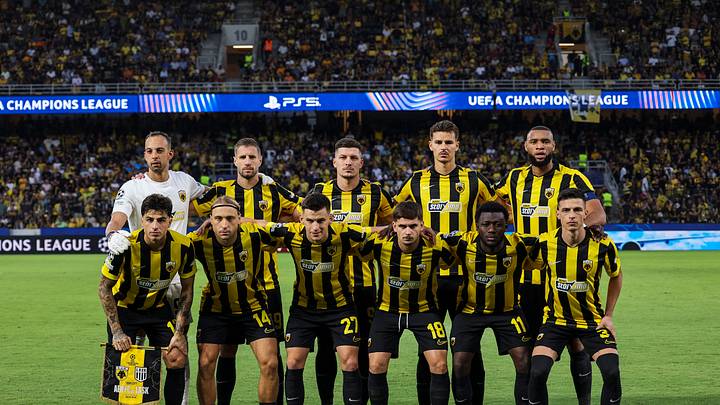
This year’s league-phase draw handed Real Madrid two away trips against two sides they have never beaten in the modern Champions League era. Everyone knows about Arsenal, who have recorded three wins and one draw in four meetings with Los Blancos. The other side, however, with an unbeaten record against Madrid is one that few know about.
Enter Wednesday's opponents AEK Athens, who recorded two draws against Madrid during the group stage of the 2002/2003 Champions League season. But what if we told you that the history between the two sides runs much deeper than that?
The must-know history between the two sides
The Greek champions’ anthem actually mentions Real Madrid by name. Madrid features in the closing lines of the anthem’s second verse, which include the lyric that says ‘Και της Ρεάλ το φόβητρο, έγινε τ όνομα σου’ which in English can be translated to ‘And your name became the nightmare of Real Madrid’.
That line references a friendly between the two sides which took place on 12 May 1965, which finished as a 3-3 draw. Friendlies back then carried a far greater significance, the European Cup was only ten years old and AEK had made their first appearance in a UEFA competition just two years earlier. So, when AEK took a two-goal lead against a side that had won 5 European Cups and featured legends like Ferenc Puskas, it was considered a monumental achievement.
Their first meeting in an official competition came in the first round of the UEFA Cup in September 1985. Real Madrid had won the competition a few months earlier but nevertheless lost the first leg 1-0 in Athens. A month later, Madrid won 5-0, with goals from legendary strikers such as Hugo Sánchez and Emilio Butragueño, as they went on to retain the title. Seventeen years later, the two sides met again.
Florentino Pérez was in the midst of his first tenure as club president and had kickstarted the Galáctico era assembling a squad featuring Roberto Carlos, Luis Figo, Zinedine Zidane and Raúl, all of whom played their part in Real Madrid winning their ninth European crown in 2002. Despite those glamorous names, they found themselves 3-1 down away to AEK. Zidane reduced the deficit, before Guti restored parity just after the Greeks had missed a one-on-one with Casillas as the encounter finished in a thrilling 3-3 draw.
20 days later, the two sides met again in Madrid but this time a brace from Steve McManaman put Real Madrid in the driving seat. That remained the case until the 74th minute when AEK midfielder Kostas Katsouranis found himself unmarked from a corner and halved the deficit. AEK struck again in the 86th minute, becoming the first team since the Champions League was revamped to avoid defeat after trailing 2-0 at half-time at the Bernabéu.
What you need to know about AEK
Twenty-four years later the two sides meet again in Athens, and a lot has changed. The stadium that hosted their last meeting was demolished in 2003. Years of financial troubles followed, with AEK forced to play at the soulless Olympic Stadium. Eventually, the situation unraveled, culminating in the club going bust and being relegated to the amateur third tier in 2013.
Two years later, AEK returned to the top-flight and in 2022 broke into their new stadium, on the grounds of where the old one laid. They have since won the league in two of the four seasons contested in their new home, narrowly missing out in 2024.

Colloquially referred to as ‘Agia Sofia Stadium’, AEK’s crown jewel serves as a bittersweet reminder of the ancestral homeland from which the club’s founders came from. The acronym AEK, pronounced as a single word, stands for ‘Athlitiki Enosi Konstantinoupoleos’, meaning ‘Athletic Union of Constantinople’ as the club was founded in 1924 by Greek immigrants who had fled the city, now known as Istanbul.

When Real Madrid visit, the ground will feel like a cauldron with 32,000 fans looking to intimidate the opposition and drive their team towards victory. Fans may spot banners and flags bearing the name ‘Original 21’, AEK’s dedicated ultra group whose members occupy the stadium’s south stand. Expect a large choreographed display or some other artistic spectacle ahead of what will undoubtedly be the biggest game of the season for the club and its supporters.
AEK’s tactical profile
Under Serbian manager Marko Nikolic, who has been in charge since the summer of 2025, AEK look to play through the middle, using quick, intricate combinations. The 47-year-old likes to deploy a double pivot and two number 10s who occupy the half-spaces. Former Real Madrid striker Luka Jovic is the most well-known player in the current squad and a key pillar to Nikolic’s system.
The 28-year-old striker joined in 2019 from Eintracht Frankfurt for a fee of €63 million, as part of the club’s attempt to rebuild the team that had won three successive European crowns. Unfortunately, he managed just three goals and five assists during his time in the Spanish capital, struggling to reproduce the form that he showed in Germany.
He has since found solace in Athens, recording 30 goals and assists across all competitions since his debut. In Nikolic’s rigid 4-2-2-2 system, Jovic likes to drop deep and showcase his passing range, receiving the ball with his back to goal before either combining with the midfield or playing it through to a runner. Two of the most important pieces to the puzzle are midfielder Razvan Marin and the side’s designated playmaker, Lovro Majer. The former is a set-piece specialist and the team’s tempo setter; the latter is the club’s second-most expensive signing and enjoys considerable freedom of movement across the midfield. His technique and decision-making have elevated AEK’s ability to play fast-paced, transitional football.
Nikolic does not subscribe to a specific tactical ideology. On Wednesday night, his team are more likely to focus on maintaining a compact block and deny space to Mbappe and co and will look to exploit transitions instead. One of his main strengths as a coach is his ability to analyse the opposition and adapt his side to the specific demands of each game.
With that said, if Jose Mourinho’s side can draw first blood early in the fixture it would go a long way towards simplifying their evening. For all AEK’s virtues, they lack experience of competing at the highest level. If Real Madrid prevent them from growing into the game and impose themselves early the undeniable gulf in quality between the two sides will become apparent. However, given the history between the two clubs and AEK’s home advantage, this could yet prove to be a tricky fixture for Madrid.
 Add us as a preferred source on Google